UGA’s Interfraternity Council offers suicide prevention training
A partnership between the University of Georgia and Greek student leaders provides some of the most comprehensive suicide prevention training in the country. This past semester, all new members of the University of Georgia Interfraternity Council (IFC) participated in QPR training. QPR, which stands for Question, Persuade, Refer, is a form of suicide prevention training that IFC has embraced for several years. QPR training teaches people how to recognize signs of suicide crisis and guide someone to professional help.
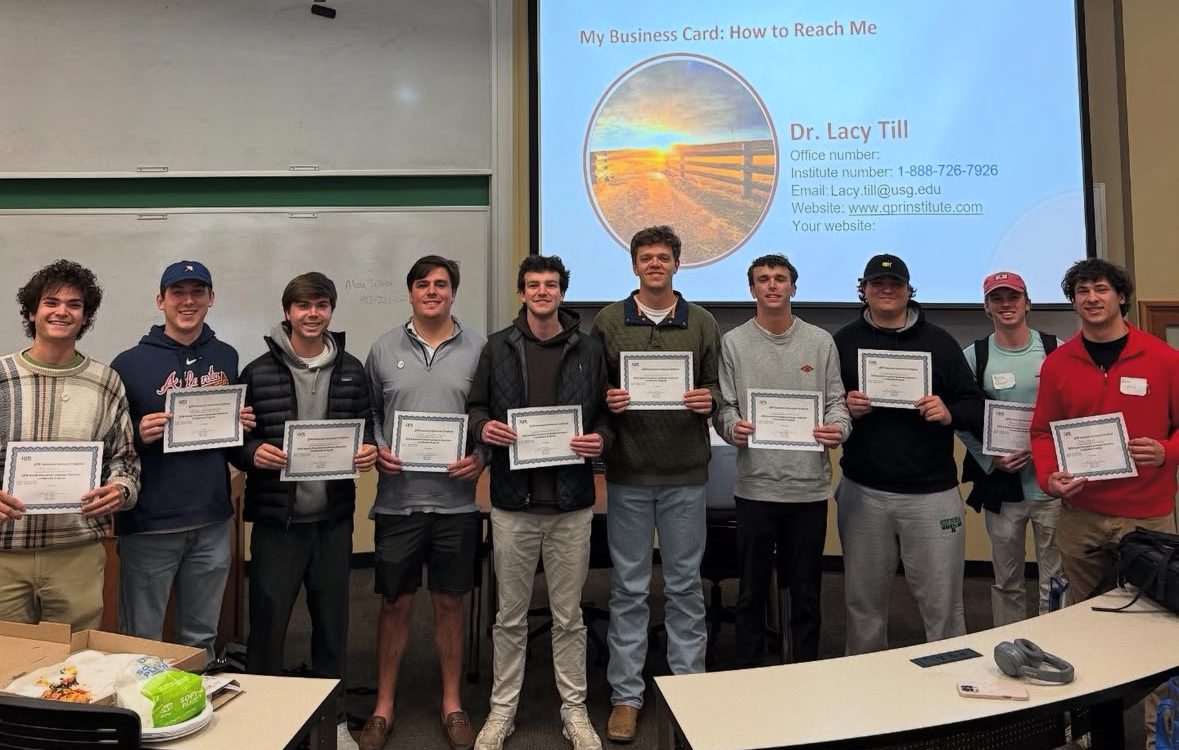
Student Care and Outreach, a unit within Student Well-being Resources, facilitates UGA’s QPR program. In the Spring of 2023, a cohort of individuals, including several IFC members, were trained to become QPR instructors. The following semester, QPR training for all new IFC members began during the six-week new member process.
Dylan Van Saun is a member of the Pi Kappa Phi fraternity and former vice president of risk management for the Interfraternity Council. Suan coordinated QPR training schedules for each chapter. In his opinion, one of IFC’s major accomplishments is its commitment to training its community members.
“Within the Interfraternity Council, we made it a goal to train every new member, around 700 students in the fall and about 150 students in the spring, each year,” he said. “After next year, every single member of the IFC community will be QPR trained.”
Several IFC members consistently signed up to train their newest members, including James Fiveash, Henry Grimsley, and Grayson Bryd.
James Fiveash, a member of Sigma Chi, sees QPR training as a way to open up the difficult conversation surrounding mental health, which is often stigmatized, especially for members of fraternities.
“From training these new members, I learned that every training that I give is very important. There wasn’t one training where I didn’t have a student come talk to me after class due to being worried about a friend or a peer,” Fiveash said. “If we hadn’t started this conversation, there may have not been a chance for the student to have been able to talk to me about it.”
Henry Grimsley, a member of Phi Gamma Delta and current IFC president, agrees. Now he views himself as somebody others can approach for help.
“Being QPR trained makes you a lighthouse, so to say. You are someone that people can come to, and you are constantly on the search for anyone who might be struggling,” he said.
Being a person who someone can approach for help is an invaluable contribution to any community. Through fostering brotherhood where people can lean on each other in times of need, the IFC is building long-lasting bonds.
Grayson Bryd is a member of Delta Sigma Phi fraternity and the most recent president of the IFC. He encourages all of his brothers to invest themselves in creating a supportive community.
“One of the main ideas of QPR and suicide prevention is that nobody is alone in dealing with it. Find your people and lean on them. Reciprocate!” Byrd said.
By familiarizing IFC members with mental health crises and equipping them with the tools to navigate challenging situations, the stigma surrounding men’s mental health begins to crumble. This type of community-wide effort is extremely important in ensuring the health and well-being of all students across campus. One word, one conversation, or one gesture can make all the difference in the world.
For more information on QPR or other Support Dawgs training, contact SCO at sco@uga.edu, or visit https://well-being.uga.edu/support-dawgs/
Anyone currently struggling with their mental health can reach a CAPS clinician by phone 24/7 at 706-542-2273, or the National Suicide Crisis Line at 988.